
 Locate Our Store
 +971 562162730
 AED
AED SAR
SAR KWD
KWD QAR
QAR BHD
BHD OMR
OMR


Introduction
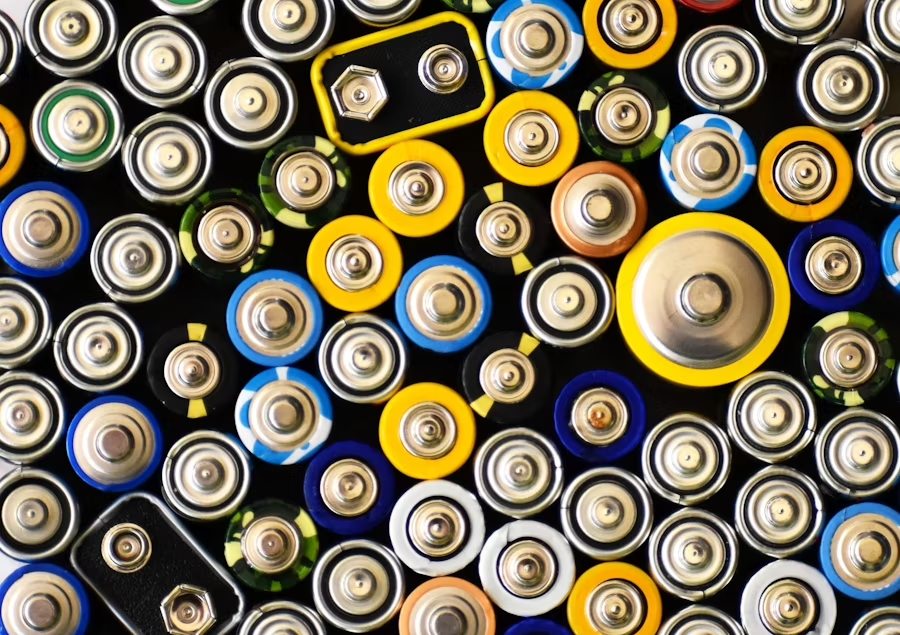
In Dubai procurement, battery RFQs go wrong for one predictable reason: suppliers are not quoting the same scope. One quote assumes a retail 2-pack, another assumes a master carton. One includes delivery and unloading, another is pickup-only. One is quoting alkaline, another quotes lithium because the RFQ just said “AA batteries”.
If you want comparable quotes, you have to design the RFQ so suppliers cannot guess. This article gives you the 14 fields that remove ambiguity and make supplier quotes genuinely comparable, including scope clarity using Incoterms, which define responsibilities between buyer and seller.
Why battery quotes are not comparable in Dubai procurement
Battery quotes usually become non-comparable because of three mismatches.
The first mismatch is specification. Battery type, chemistry, and pack format can change price drastically even when the size looks the same.
The second mismatch is delivery scope. Without stating whether the supplier is responsible for delivery, clearance, duties, and last-mile handling, you are comparing a “product price” from one supplier with a “landed price” from another. Incoterms exist specifically to reduce these misunderstandings by defining responsibilities in sales contracts.
The third mismatch is quality and compliance expectations. A supplier may quote the cheapest available stock, while your organization needs minimum shelf-life remaining, DOA rules, and documentation for lithium shipments such as UN 38.3 test summary support expectations.
The 14 RFQ fields that force comparable battery quotes
Below are the 14 fields you should include in every battery RFQ. If you already have an RFQ template, you can treat this as a checklist and plug the missing fields into your current form.
-
Buyer identity and billing requirements
Include legal entity name, contact name, phone/email, and any invoice requirements your finance team needs. If you are VAT-registered and require VAT-compliant invoicing, state that clearly since UAE VAT applies at a standard rate of 5% introduced on 1 January 2018. -
Delivery address as a named place
Do not write “Dubai”. Provide the exact delivery location including building, area, and receiving point, because delivery effort and access constraints materially affect cost. -
Receiving constraints and delivery windows
State your receiving days and hours, whether appointment is required, and any site restrictions (vehicle type, gate pass, unloading support). Without this, suppliers price based on assumptions and you get hidden add-ons later. -
Delivery scope using a clear Incoterm
State the Incoterm and the named place (example: DAP your warehouse, or DDP your warehouse). Incoterms define who is responsible for transport, risk transfer, and other obligations, and DDP is specifically listed as Delivered Duty Paid with a named place of destination.
If you are not sure which term to use, ask suppliers to quote two options, but specify that both options must be quoted for the same named place. -
Battery chemistry and type
State whether you want alkaline, lithium (primary), or rechargeable (such as NiMH). This is the most common source of quote mismatch because “AA” alone is not enough. -
Size, form factor, and voltage where relevant
Examples: AA LR6 1.5V, AAA LR03 1.5V, 9V, CR2032 coin cell. If you are replacing a device-specified battery, include the exact reference (like CR2032 vs CR2025). -
Use case and performance expectation
Keep this short: “office peripherals”, “remote controls”, “sensors”, “high-drain devices”, “emergency equipment”. This helps suppliers quote an appropriate product within your approved chemistry without pushing unsuitable substitutions. -
Brand or equivalency policy
State whether brand is fixed, or whether “approved equivalents” are allowed. If equivalents are allowed, define how approvals happen and whether supplier must list the equivalent brand/model in the quote rather than swapping silently. -
Pack format and master carton configuration
Specify the pack format you will evaluate on, such as 2-pack, 4-pack, 10-pack, or bulk master carton. Also specify whether you want inner packs intact or are open to bulk cartons for internal consumption. Pack format drives unit economics and is a core reason quotes are not comparable. -
Quantity per line item and the purchasing pattern
State exact quantities per SKU and whether this is a one-time buy or part of a recurring program. If recurring, give an estimated monthly or quarterly cadence. Suppliers can quote better and more consistently when they know the pattern. -
MOQ, price breaks, and whether breaks apply per SKU or per basket
Ask for tier pricing that reflects your likely buying pattern. Also ask whether price breaks require ordering one SKU in bulk or whether they apply to a combined basket across sizes and SKUs. -
Documentation and compliance pack requirements
At minimum, request SDS/MSDS for the battery type you are buying where relevant to your internal compliance process. For lithium, include a request for UN 38.3 test summary support or traceability expectations. PHMSA explains lithium batteries must be subjected to UN 38.3 design tests and the test summary requirement was effective January 1, 2022 and revised effective May 10, 2024. -
Shelf-life remaining and date code expectations
State a minimum remaining shelf-life at time of delivery (for example, “minimum 12 months remaining” or “minimum 18 months remaining”, whatever your policy is). Without this, one supplier may quote fresh stock and another quotes older discounted stock. -
Commercial terms and quote controls
Request quote validity period, payment terms, delivery lead time split into dispatch time plus transit time, VAT treatment (included or excluded), and whether split shipments are allowed. UAE VAT at 5% is a known baseline factor for internal budgeting and invoice consistency.
Common RFQ mistakes that inflate landed cost
The fastest way to overpay is to let suppliers fill in blanks for you.
A vague description like “AA batteries” makes suppliers choose different chemistries, different pack formats, and different quality grades. You are then comparing different products, not different prices.
Missing delivery scope is the next major mistake. If you do not anchor your RFQ to an Incoterm and a named place, you will get quotes that include different responsibilities for transport, clearance, duties, and last-mile delivery, and Incoterms are specifically intended to clarify these responsibilities.
Not stating shelf-life remaining is a common hidden cost. Old stock may look cheaper but causes higher returns, lower performance complaints, and greater waste.
Finally, lithium requirements are often treated as “same as alkaline.” If you buy lithium and you do not request documentation expectations up front, your quote may not include the cost and time impact of compliance handling and evidence such as test summary support expectations.
A simple evaluation method: scoring quotes without bias
To keep comparisons fair, evaluate each quote in two layers.
First layer is compliance to your RFQ fields. A quote that does not explicitly answer the 14 fields is not comparable, even if the unit price is low.
Second layer is economics and reliability. Once quotes are compliant, compare:
Product unit economics based on the same pack format and same SKU definition; delivery lead time split into dispatch plus transit; substitution policy risk; and shelf-life remaining offered.
If you want a simple internal rule that prevents bad decisions: do not award based on unit price unless the quote is fully comparable on scope, quality, and documentation. Incoterms and defined responsibilities exist to prevent exactly this kind of misunderstanding.
CTA: Standardize your battery RFQ with Sea Wonders
If you are building a consistent RFQ process, it helps to align your buying path with clear battery categories and pack formats so users cannot accidentally request mismatched items. Sea Wonders’ batteries category structure can support that buying discipline, especially when you standardize around a small approved list.
FAQs
What is the single most important field to make battery quotes comparable?
Delivery scope anchored to a named place and Incoterm, because it defines responsibilities and prevents hidden costs from being excluded.
Should Dubai RFQs ask for UAE VAT handling?
Yes, because UAE VAT is applied at a standard rate of 5% introduced on 1 January 2018, and quotes should clearly state whether VAT is included or excluded.
When should we request lithium documentation like test summaries?
When you are sourcing lithium batteries or any supply chain where lithium transport compliance and traceability matter, since the UN 38.3 test summary requirement is a defined expectation in lithium battery transport contexts and has been updated.
Conclusion
Comparable quotes are not a supplier problem. They are an RFQ design problem. If your Dubai battery RFQ includes the 14 fields above, suppliers cannot guess scope, cannot silently change pack formats, and cannot quote different chemistries under the same size label. You will get clean comparisons, faster approvals, and fewer surprises after the PO is issued, especially once you anchor scope using Incoterms and capture VAT and lithium documentation expectations up front.


